Every service Pineapple Blueprint offers is proven in our own AI testing sandbox first. I've worked with AI since 2021, when I was in biotech and we trained a marketing intelligence model. For over a year we've built and tested with it here, tracking every prompt and design decision, and our own custom agents do real business work in the sandbox and learn from every decision we make. What passes becomes the method we bring to clients.
Gartner predicts 40% of agentic artificial intelligence (AI) projects will be canceled by 2028, citing rising costs, unclear value and weak risk controls. Their fix is a five-step data readiness checklist. It's a good list, but it stops at the data. It doesn't ask the question I've spent 15+ years designing for: can the person in the loop actually see, trust and correct what the agent did?
So we added a sixth step and built all six into the sandbox. It runs real workloads: agents that handle day-to-day business operations, and a design agent trained on one designer's taste: mine. Here's what we're building and what we've learned. We're sharing the moves, not the playbook.
What are the six steps to AI agents worth trusting?
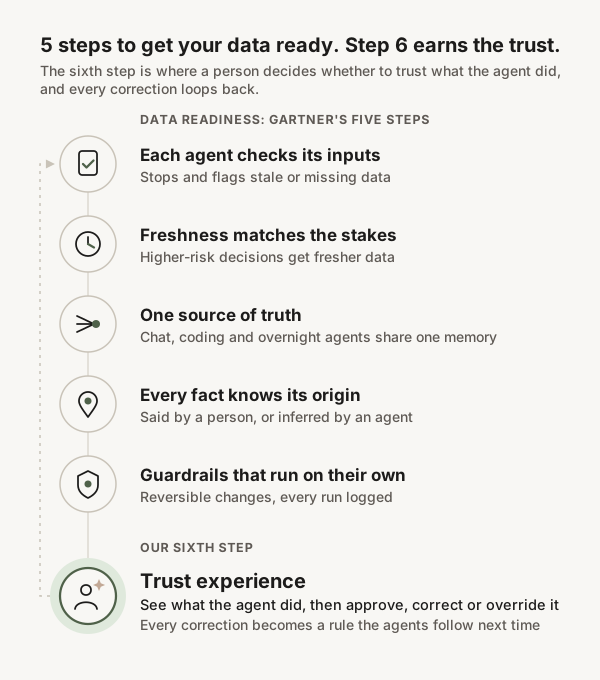
1. Every agent checks its inputs before it acts
Each of our agents declares what it needs to do its job and how fresh that data has to be. If an input is stale or missing, the agent stops and says so instead of guessing. The declaration format is one of the things we've refined most in the sandbox, and it stays in house.
2. Freshness matches the stakes
Not every agent needs live data. We sort decisions by what a wrong call would cost, then set freshness by tier. Learning: giving every task a shelf life keeps agent reports focused on what matters now, so people act on them instead of skimming past them.
3. One source of truth, with rules about who writes
Our chat assistant, our coding agent and our overnight agent read from the same memory. Storage was the easy part. The real design work was deciding which agent is allowed to write what, and when a person has to approve it.
4. Every fact knows where it came from
Every line in our shared memory is labeled with its origin and date. The most useful distinction turned out to be simple: did a person say this, or did an agent infer it? Agents treat those two very differently.
5. Guardrails that run on their own
Nothing our agents do deletes anything. Every change is reversible and every run is logged, the same idea behind putting an AI agent on rails. Learning: checking the live system after every change, not just the instructions behind it, means what an agent reports is what actually happened.
6. A trust experience for the person in the loop
This is the step Gartner's list leaves out, and it's where our design-taste agent lives. Before it touches real work, it has to match my call on a set of past design decisions. Every time I correct it, the correction becomes a rule it follows next time. We recently mined about 2,500 past conversations in an afternoon and reviewed the results by hand into 151 approved rules that every session now loads. How we score the match is the part we're keeping close.
AI gets you close. Precision and delight still take craft.
What are we measuring?
We're capturing baselines before each change, and we'll report the same numbers at 30, 60 and 90 days:
- Hours per week spent checking or redoing agent work
- Agent errors caught before they reach a person, versus after
- Tasks closed versus tasks created
- How often the design-taste agent matches my call, and how many revision rounds it saves
As results come in, we'll publish them here, so every recommendation we make has real-world proof behind it.
Why do our services start in the sandbox?
Advice about AI trust is easy to give. Proof takes real work. Because every step is trained and tested in our sandbox first, each recommendation we bring to a client is already backed by real workloads, real deadlines and a real designer's judgment.
The sandbox isn't the only proving ground. Many of these tactics have already been applied in commerce, marketing, fintech and healthcare, where getting trust wrong costs real money and real people.
Piloting agents you can't yet trust unsupervised? Pineapple Blueprint runs an Agent Readiness and Trust Audit built on these six steps.
Book an advisory introFrequently asked questions
What is agentic AI data readiness?
It means the data an AI agent acts on is current, complete, consistent across systems, labeled with where it came from, and governed by automated checks. Gartner frames it as five steps, from checking each agent's inputs to continuous guardrails.
Why do AI agent projects get canceled?
Gartner predicts 40% of agentic AI projects will be canceled by 2028, citing rising costs, unclear business value and weak risk controls. Most of those failures trace back to data the agent can't trust and decisions people can't see.
What is the trust experience for AI agents?
It's the part of the product where a person sees what an agent did and why, then approves, corrects or overrides it. Each correction becomes a rule the agents follow next time, so trust grows with use.